
June 13th, 2026
Announcement: Printed Decks
Square Forge printed decks are moving from concept toward a structured product offering. The system has always been available as a printable PDF, and that option will remain unchanged for users who prefer to print their own copies. The printed edition introduces a new constraint: translating a flexible procedural system into a physical deck that is practical to manufacture and use.
Printed Deck Size
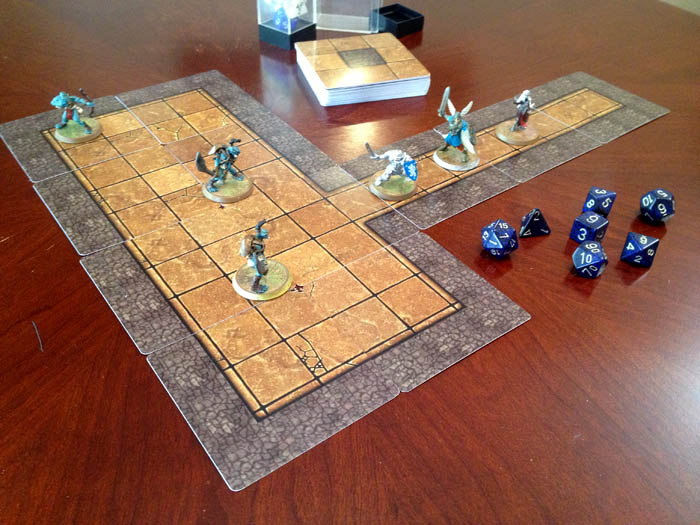
The original system began with 16 tile patterns used in personal campaigns. After sharing the concept publicly, the set expanded to 30 patterns and eventually doubling to 60 as variations were introduced. A key constraint in physical decks is repetition. Single-copy patterns are not practical in use, since tiles must appear multiple times during construction.
Scaling duplication across a large set quickly produces oversized decks. For example, 16 patterns replicated four times results in 64 cards, while 60 patterns at the same rate results in 240 cards. At that size, the deck becomes impractical to print, store, and use efficiently.
The intended range is a compact physical deck between 60 and 90 cards. Within this range, frequently used patterns can be weighted more heavily without making the system unwieldy. A 90-card deck provides enough flexibility while remaining manageable in practice.
Organizing The Deck
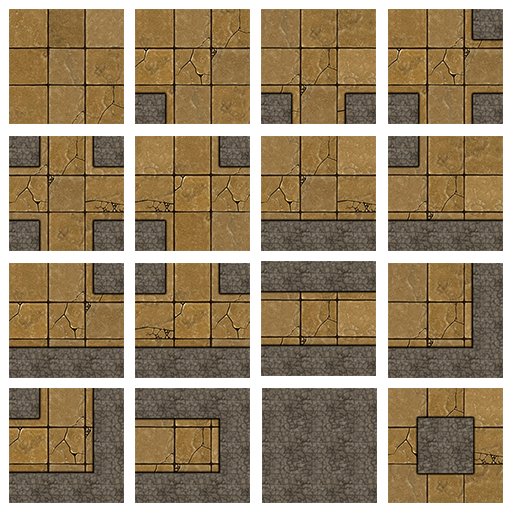
The original patterns come from procedural map generation techniques used in game development. They were reduced from a larger design system into a minimal tile set intended for rapid generation.
The design prioritizes flexibility over completeness, and does not attempt to cover every possible dungeon style or hand-drawn layout. As a result, certain features such as diagonal corridors or complex organic room shapes are intentionally outside the scope of the system.
The system is intended for real-time dungeon generation rather than replication of pre-written maps. Dungeon Masters build layouts dynamically during play rather than reproducing fixed designs. The original 16-card system has been tested extensively and remains stable for this use case.
The printed deck begins with a 4x4 grid of the original patterns. Duplication is assigned based on usage frequency. The open floor tile is the most frequently used and receives 10 copies. Common structural tiles such as walls, T-sections, hallways, and corners receive 8 copies each. Remaining patterns receive 4 copies each, resulting in a 90-card deck.
What Comes Next
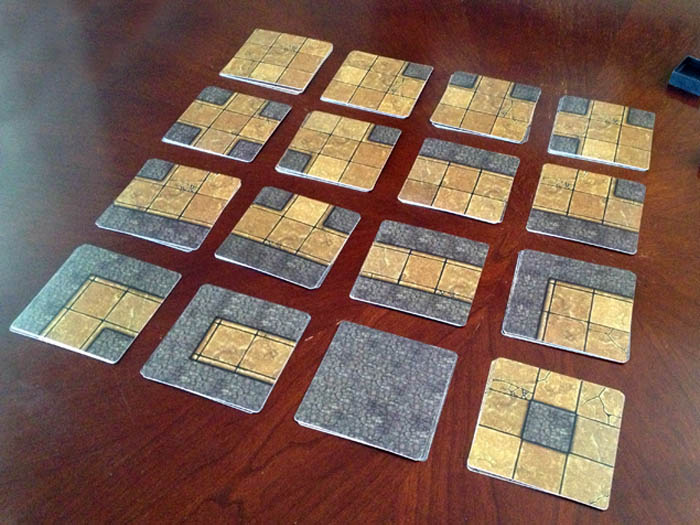
Production is currently on hold while the card visuals are redesigned. The underlying system is stable, but the current graphics are not at final production quality.
The next revision focuses on improving clarity, consistency, and overall visual polish. The current prototypes are functional but show inconsistencies in sharpness and texture. These are suitable for testing but not for final print production.
Booster Deck Idea
A secondary product format is also being explored: smaller booster-style decks without duplicates. These would allow users to assemble custom collections by combining themed sets as needed.
Each booster would focus on a specific category of tiles, such as corridors, rooms, or structural variations. This approach allows users to expand their deck gradually and tailor it to their campaign style.
Feedback Appreciated
If you have suggestions for what you would like to see in the printed decks, or ideas for improvements, feel free to reach out via the contact page. Feedback is welcome and helps guide future printed editions.